
Artificial intelligence is often presented as a technology that will transform every aspect of business.
This can make AI appear complicated, expensive or relevant only to large international organisations.
In reality, businesses do not need to begin with an advanced AI system. Many organisations can create value by applying AI to small, clearly defined activities.
AI tools can help employees find information, prepare documents, understand data and respond to routine questions. The goal is not to introduce AI everywhere. It is to identify areas where it can safely improve speed, consistency or decision-making.
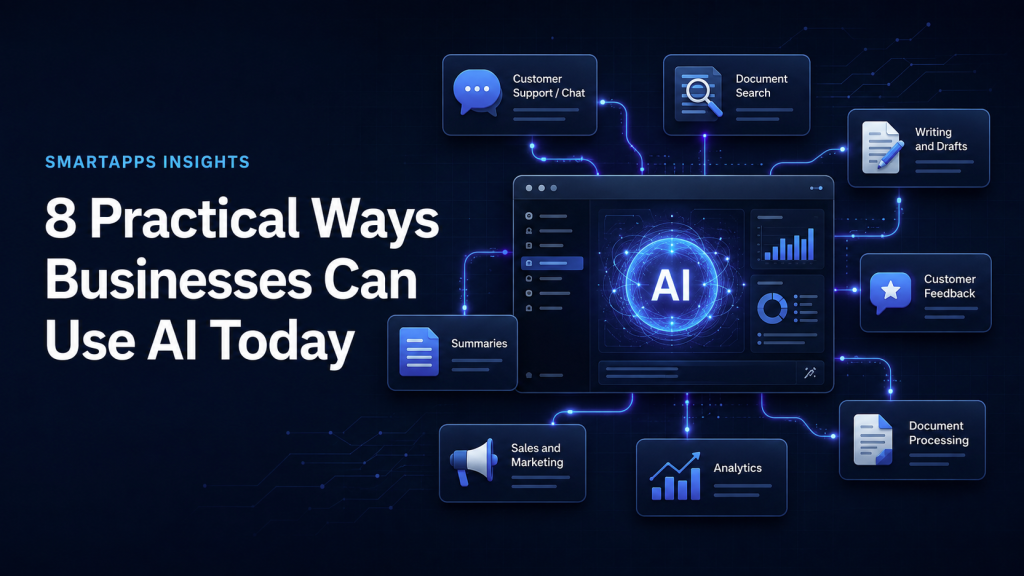
Here are eight practical ways businesses can begin using AI today.
1. Answering common customer questions
Customer service teams regularly receive similar questions:
- What time do you open?
- How much does the service cost?
- How can I make a payment?
- Where is my order?
- What documents do I need?
- How do I reset my password?
- When will my request be completed?
An AI-powered assistant can provide immediate answers to approved, frequently asked questions.
It can operate through a website, customer portal or internal support system. If the question is too complex or sensitive, the assistant can transfer the conversation to a member of staff.
This allows employees to spend more time handling issues that require judgement and personal attention.
The assistant should use verified information supplied by the organisation. It should not be allowed to invent policies, prices or commitments.
2. Finding information in business documents
Organisations often have valuable information stored across:
- Policies
- Procedure manuals
- Reports
- Contracts
- Product documents
- Meeting notes
- Training materials
- Shared folders
Finding a specific answer may require employees to search through several files or ask another department for assistance.
An AI knowledge assistant can help authorised employees search approved documents using ordinary questions.
For example, an employee could ask:
What is the approval procedure for a purchase above a certain amount?
The assistant can locate relevant information and identify the source document used to prepare its response.
Access permissions remain important. Employees should only receive information they are authorised to view.
3. Preparing first drafts
Employees spend significant time preparing routine written material.
AI can help create the first draft of:
- Emails
- Proposals
- Reports
- Product descriptions
- Meeting summaries
- Internal announcements
- Customer responses
- Social media content
The employee remains responsible for reviewing and approving the final version.
AI-generated content may contain incorrect information, unsuitable language or details that do not reflect the organisation’s position. It should therefore be treated as a starting point rather than a finished document.
A good process combines AI speed with human knowledge and accountability.
4. Summarising long documents
Long reports, policies and meeting transcripts can take considerable time to review.
AI can produce an initial summary that identifies:
- Main topics
- Important decisions
- Action items
- Deadlines
- Responsibilities
- Areas requiring further attention
This can help managers understand the document before conducting a more detailed review.
However, summaries should not replace the original document when legal, financial or strategic details are important. AI may overlook qualifications or context that affect the meaning.
Employees should verify important conclusions against the source.
5. Analysing customer feedback
Customers provide feedback through surveys, reviews, support requests, emails and social media.
When the volume becomes large, it can be difficult for employees to identify common patterns manually.
AI can help group feedback into themes such as:
- Pricing concerns
- Service delays
- Product quality
- Staff communication
- Technical problems
- Requested features
- Positive experiences
It can also help identify whether feedback is generally positive, negative or neutral.
This gives managers a broader view of what customers are experiencing. Employees should still examine individual feedback, especially complaints or issues requiring action.
6. Supporting sales and marketing teams
AI can assist sales and marketing teams with research, preparation and personalisation.
Possible uses include:
- Organising potential customer information
- Summarising previous customer interactions
- Suggesting follow-up messages
- Drafting campaign ideas
- Creating content variations
- Identifying recurring customer interests
- Preparing meeting notes
- Prioritising enquiries using defined criteria
The organisation must be careful when using personal information for marketing. Customer data should be collected and processed responsibly, with appropriate permission and security.
AI recommendations should support employees rather than automatically making important decisions about customers.
7. Understanding business data
Many organisations collect data but struggle to turn it into useful information.
AI-supported analysis can help employees explore data using natural-language questions, such as:
- Which services received the most enquiries this month?
- Which products experienced the greatest change in sales?
- How long does it usually take to approve a request?
- Which customer issues appear most frequently?
- Where are operational delays occurring?
The quality of the answer depends on the quality of the underlying data.
If records are incomplete, inconsistent or outdated, AI may produce misleading conclusions. Organisations should therefore improve their data collection and validation processes before relying on AI-generated analysis.
Important decisions should still be reviewed by qualified employees.
8. Automating document processing
Many business processes begin with a document.
This may be an invoice, application form, delivery note, receipt, contract or identification document.
AI can help extract relevant information and enter it into a business system. For example, it may capture:
- Names
- Reference numbers
- Dates
- Invoice totals
- Contact details
- Product quantities
- Document categories
The extracted information should be checked before it is used for payments, approvals or other high-impact actions.
Document-processing automation is particularly useful when employees repeatedly copy the same types of information from standard documents.
Where should a business begin?
AI adoption should begin with a specific business problem.
Avoid starting with a general goal such as “we need to use AI.” Instead, identify an activity that currently takes too much time, creates inconsistent results or prevents employees from accessing information.
A suitable first AI project should normally be:
- Clearly defined
- Limited in scope
- Easy to test
- Based on available information
- Low risk
- Measurable
- Supervised by responsible employees
For example, an internal assistant that searches approved staff policies may be safer as a first project than a system that makes automatic financial decisions.
Questions to ask before introducing AI
Before implementing an AI solution, consider the following questions.
What problem will it solve?
The organisation should be able to describe the expected improvement clearly.
What information will it use?
Determine where the information comes from, whether it is accurate and who is permitted to access it.
Does it involve personal or confidential data?
Sensitive information may require additional security, access restrictions and legal consideration.
What happens when the AI is wrong?
There should be a clear process for reviewing, correcting or escalating unreliable results.
Which decisions require human approval?
AI should not make high-impact decisions without appropriate human oversight.
How will performance be measured?
Measures may include time saved, response speed, employee adoption, accuracy or customer satisfaction.
Protecting business information
Employees should not place confidential business or customer information into public AI tools unless the organisation has approved the tool and understands how the information will be processed.
Businesses should establish clear rules covering:
- Approved AI tools
- Information employees may enter
- Prohibited information
- Human review requirements
- Access permissions
- Record retention
- Reporting incorrect or unsafe results
AI security is not only a technical responsibility. Employees need training so that they understand how to use the tools appropriately.
AI should support people
The most valuable role of AI is often to support employees rather than replace them.
AI can process information quickly, recognise patterns and generate drafts. People provide context, judgement, empathy and responsibility.
A customer may appreciate receiving an immediate answer to a simple question. But a sensitive complaint may require a thoughtful conversation with an experienced employee.
A manager may use AI to identify a trend in operational data. The final decision should still consider business conditions that may not appear in the data.
Strong AI solutions combine the strengths of technology with meaningful human oversight.
Avoid introducing AI without a plan
AI projects may fail when organisations:
- Begin without a clear problem
- Use poor-quality information
- Expect complete accuracy
- Ignore security and privacy
- Exclude employees from the design process
- Automate unsuitable decisions
- Fail to measure results
- Attempt to transform everything at once
A smaller, well-managed project can produce more value than an ambitious system that employees do not trust or understand.
Turning AI into practical business value
AI is not valuable simply because it is new.
Its value comes from helping an organisation provide better service, reduce repetitive work, find information more quickly or make more informed decisions.
The most effective approach is to begin with one realistic use case, test it carefully and expand only after it demonstrates value.
Smart Apps Limited helps organisations identify practical AI opportunities, prepare their information and develop solutions designed around real business requirements.
If you want to explore how AI could support your organisation, contact Smart Apps Limited to begin with a practical AI readiness discussion.

